
Control Resonant, much like the inside-out, interdimensional cryptids it has you bashing with a shapeshifting stick, probably shouldn’t exist. At least not in the risk-averse, pennypinching reality that sometimes seems to have enveloped the art of gamesmaking, and that may have installed some scepticism into my own head. The sequel to a liked yet slow-selling shooter, which replaces both the original’s player character and its instantly recognisable, bureauca-brutalist setting, while violently pirouetting into open-world RPG melee brawling. Five words that Remedy, in all their thirty years of existence, have never previously let pass their lips.
But exist it does, which is fortunate, because the gamble pays off spectacularly. Resonant’s reality-bending trip across a kaleidoscopic Manhattan is as rich in stark views, eerie atmosphere, and creative quests as Control’s Oldest House ever was, driven along by strong character-first storytelling and Remedy’s best action in ages.
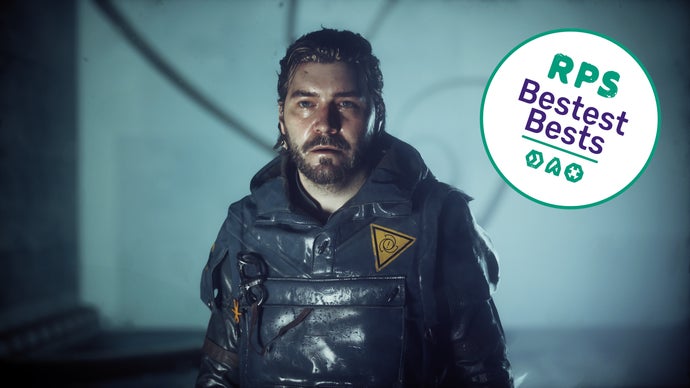
There is a lot of that action, so it seems like a good place to start. Control Resonant makes big changes on both sides of its fights, starting with the fact you are now Dylan Faden, brother and formerly brainwashed foe to Control’s Jesse. A sort-of free man for the first time in decades, Dylan takes to heroics with a weary but honest determination, fueled by the combined guilt over his prior bodypuppet misdeeds and concern for his now-missing sibling. Who, at least, grants him a parting gift of the Aberrant, which looks like it came from the same transforming amarments factory as Jesse's Service Weapon - just for swinging rather than shooting. Meanwhile, the people-warping Hiss and Mold are back as the main opponents, but in a positive departure, the enemy line-up is heavier on properly twisted, otherworldly foes than simple humanoids. Think floating, fuzzy megaspores, towering armless lumps with spikes for faces, and on several occasions, possessed buses. Mamdani’s New York, eh.
Mathematically, combat starts simple. Each Aberrant form - i.e., your weapons - gets its own button and a three-hit combo. Primary and secondary forms have three choices each, a kind of Whacking Things Greatest Hits of hammers, scythes, and nunchuks, plus your pick of a distinct combo finisher.
Pick up the cadence of these one-against-all battles, though – and factor in the active combat abilities you earn through boss victories – and Resonant’s melee starts clicking. And expanding. And exploding. Encounters are relentless, a barrage of enemy attacks matched only by Dylan’s own supernatural damage dealing, both parties busting their moves in storms of sparks, debris, and extradimensional haze. Aberrant hits and power deployments flow into each other beautifully, and even without engaging the manual lock-on, the game is uncannily good at interpreting which foe you’re trying to strike, so there’s little cause for frustration as you rapidly flick between opponents.
After a few upgrades, it’s possible to craft reliable stance break builds, particularly through combinations of the status effects that certain abilities specialise in. This can then turn Resonant’s already-satisfying slugging matches into something that resembles Doom Eternal as much as Devil May Cry, Dylan whooshing around arenas to chain together executions (themselves as gratifyingly animated as Doom’s) and snowball off their strength, healing, and poise damage buffs.
I still think the original Control’s combat is better than it’s sometimes described, especially if you invest in furniture-throwing, but it simply isn’t as dynamic or aggressive as this. Parrying? Never heard of it – Dylan has a dodge, but the skill tree tunes even that to serve as a proactive attack-boosting tool, rather than just a means of avoiding harm. Resonant wants its players to push. Begs for it, practically, and nearly thirty hours in, I’m still happy to oblige.
The only places where Remedy’s character action inexperience peeps through are the boss battles. Some genuinely are enjoyable, one-on-one paranatural duels, though others are overly simple, their sense of threat owed to massive health bars and the sheer damage of their attacks – not the challenge of recognising and avoiding them. They do all have the striking and memorable visual design you’d want from an action-RPG boss, at least, and their reward of potentially build-altering new combat powers meant I never felt I was wasting my time going after them.
سەرچاوەی فەرمی بە زمانی ئینگلیزی: https://www.rockpapershotgun.com/control-resonant-review