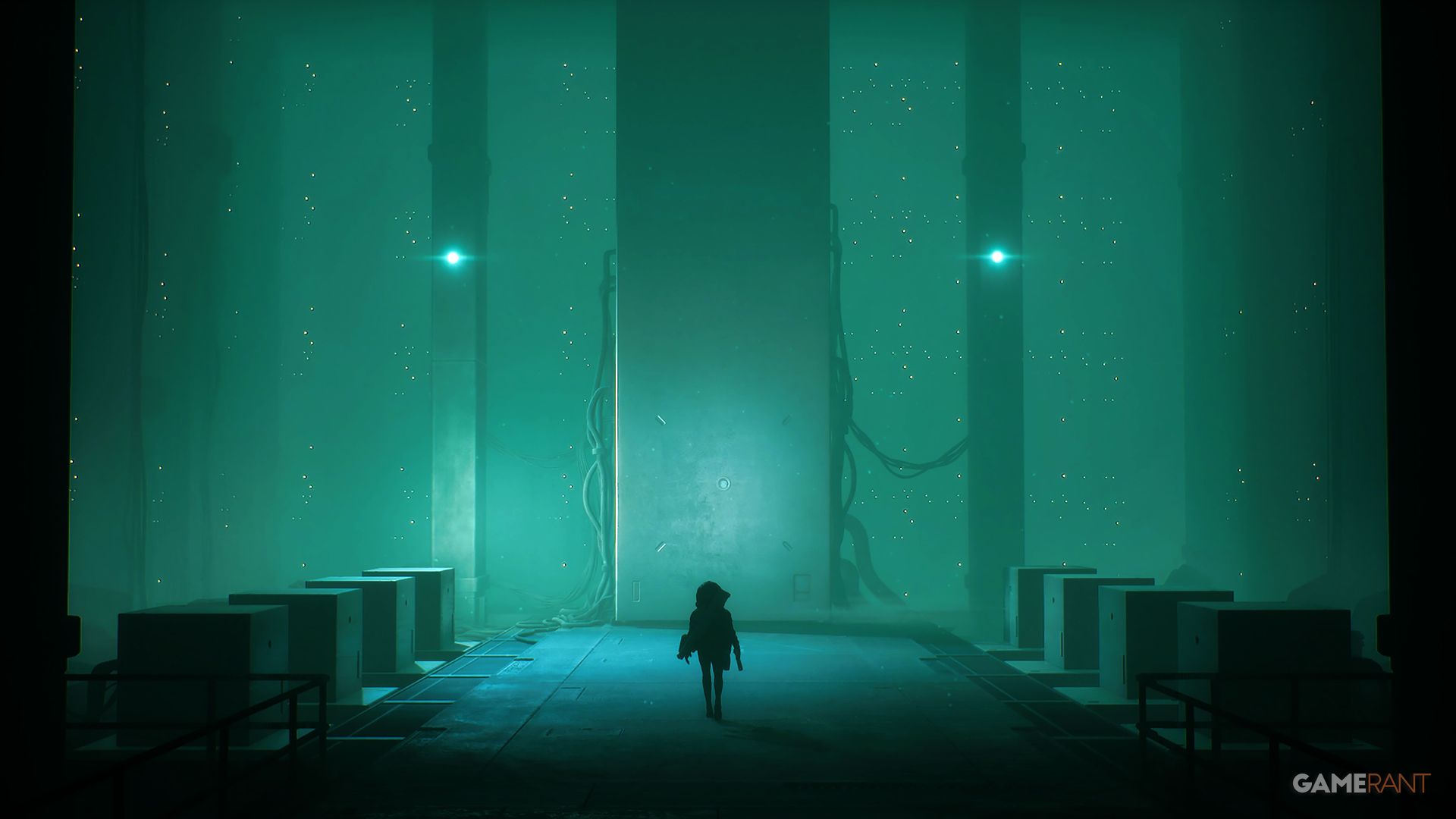
It’s easy to look at End of Abyss and expect another game in the vein of Little Nightmares. After all, Section 9 was founded by former Tarsier Studios developers, and the company’s debut title has unsettling creatures and oppressive environments. But End of Abyss takes that foundation in a very different direction, putting a gun in its protagonist’s hands and building a sci-fi Metroidvania with interconnected levels, twin-stick shooting, upgrades, and lots of exploration. The result is an atmospheric adventure that is successfully compelling, even if it doesn’t quite deliver the horror experience that its presentation suggests.
Players find themselves occupying the jumpsuit of Cel, a combat technician sent to investigate a mysterious underground facility after communications are lost. What follows is a journey through a compound full of abandoned machinery, dimly lit corridors, and unwelcoming mutants. It’s an oft-visited trope, but combined with the environmental storytelling and deliberately scarce information, the world created by Section 9 is incredibly engaging to explore. And despite having plenty of reasons to, I didn’t want to put down my controller until I’d reached the end. Even then, I wished there were more.
It is very easy to get sidetracked in the game’s meandering hallways, tunnels, and walkways. After the initial areas, the Metroidvania opens up and welcomes poking into corners, scanning gunk-covered walls, and blowing up obstacles to uncover hidden goodies. As expected of the genre, there is a lot of backtracking and map scouring as new equipment and upgrades are unlocked, and there are plenty of optional rooms to peek into.


Unfortunately, this is also where one of the biggest problems emerges. At least at the time of writing, End of Abyss does not feel release ready. It is the buggiest game I’ve played this year, and frankly, at times I felt like a surrogate QA tester. The issues become evident fairly quickly into the game. Scanning doors and other key elements would ideally cause the map to update, marking whether they’re locked, looted, or which key is required to open them. It’s also possible to add manual markers as little reminders.
However, the map often failed to update correctly or showed outdated information. A door that had been opened would retain its red “locked” icon, for example, or an explored room would remain grayed out. Some rooms simply never appeared on the map, or permanently inaccessible areas would be marked with a door icon as if they were. Though clearly designed to facilitate the backtracking inherent in a Metroidvania, the map was often part of the problem. Ultimately, a notepad proved to be a more reliable way to track areas worth a revisit.
The performance issues didn’t stop with the map, either. I encountered numerous bugs during my time with End of Abyss, from minor hiccups like placeholder button prompts to crashes to the PS5 dashboard. Some of the more exasperating included getting trapped in rooms and having to grenade myself to death to escape, bosses failing to reset, an invisible wall, becoming stuck on the environment, and falling through the world. Restarting the game and losing progress became a regular occurrence. Crashes were particularly frustrating because they could occur after major encounters, like right as I was celebrating downing a tough boss.
Another caveat is that End of Abyss is not a horror game. In fact, it’s not scary at all. Though it’s been described in the past as a survival horror, it’s best described as a dark sci-fi Metroidvania. Item and resource management are part of the experience but not central to it, and by the halfway point, Cel is overflowing with fragments, the game's currency. Instead of the player feeling powerless, the game provides weapons, upgrades, and increasingly effective ways to fight back. Add to that the asymmetrical difficulty curve, and the horror rarely reaches the level of tension associated with Tarsier’s games. Those expecting Little Nightmares with combat may feel let down.
End of Abyss uses twin-stick controls, meaning Cel can move and aim independently. The pistol has unlimited ammunition, although it needs to recharge, while other weapons and consumables are limited. The problem is that aiming is awkward, particularly during more demanding encounters. The game requires a degree of precision, but even when fully upgraded, aiming with the pistol could sometimes feel like an enemy itself. It’s manageable against weaker enemies and when there’s room to strafe and kite, but it becomes much more frustrating when facing hordes of enemies or bosses.
سەرچاوەی فەرمی بە زمانی ئینگلیزی: https://gamerant.com/end-of-abyss-review/