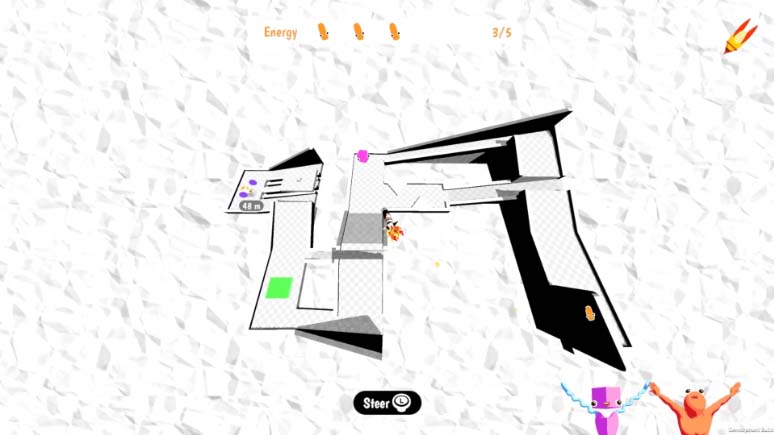
Getting a hole in one is the pinnacle of every mini golf game, but what would a hole in zero look like? How would you even score without touching the ball? The answers we came up with sound like cheating: swapping balls with opponents, calling in airstrikes, letting your ball grow legs. They were absurd for a golf game… But we built them all anyway in Golftacular! And we’re thrilled to announce that it’s coming to Xbox Series X|S and Xbox One today!
We’re Justin, Luca, and Pedro from Both Good Games, and we want to share how we studied every mini-golf cliché just to allow you to cheat your way past all of them. When we decided to make a party game, mini golf kept coming back up in brainstorm sessions. As a foundation, it felt simple and familiar enough that anyone could pick it up in seconds, while having plenty of room to build new ideas onto. And the more we actually designed mini-golf courses, the more we discovered just how many different approaches we could weave into our courses.
So, once we settled on an idea, we did what every game designer has to do: we played a ton of games. We even took a field trip to actual mini golf courses for inspiration! As we trekked our way through dozens of courses, both real and virtual, we took note of every trope and obstacle that seemed of potential use.
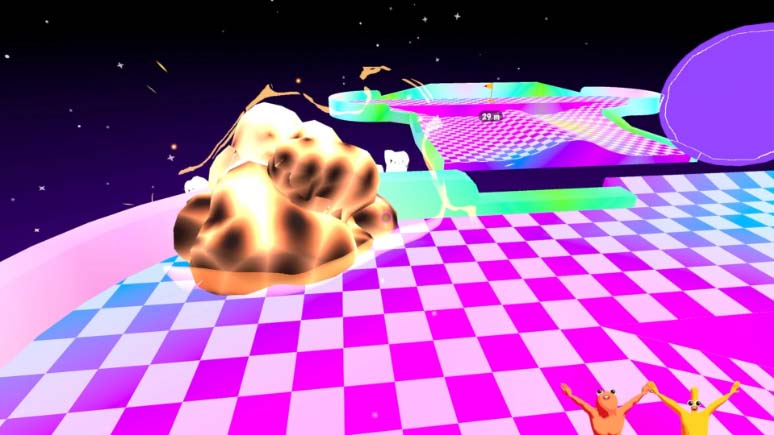
The result was a toolbox of components that eventually defined the basis of our maps. We gave them names like “Thread the Needle”: which described sections that required precise aim for the most direct route. Or “Wall Rides”, which were ramps that required a good understanding of strength and the relationship between inclines and distance. Or simply “The Mixers”: spinning obstacles that push the ball around and strike a good balance between skill, timing, and randomness.
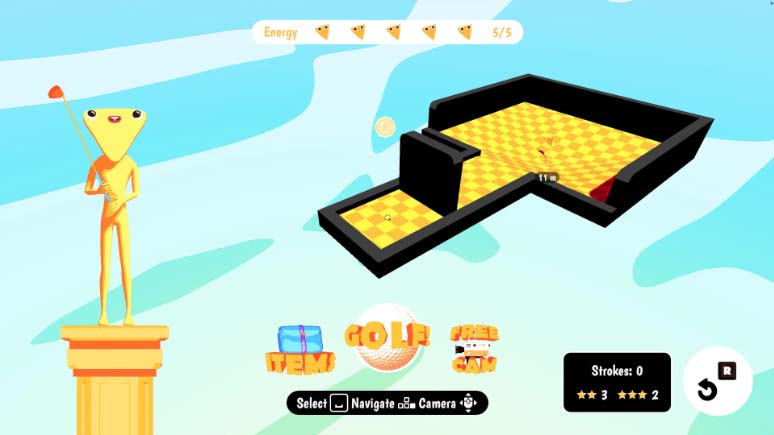
With our new set of tools handy, we designed our maps in four phases. First, we drew them out in 2D. These prototypes allowed us to explore ideas quickly, testing what layouts worked or not, while also creating the groundwork for phase two. Once a course layout was deemed worthy, we would quickly model a bare bones version lacking textures, nonessential walls, and even a few collisions. As soon as these maps were playable, we moved straight to playtesting.
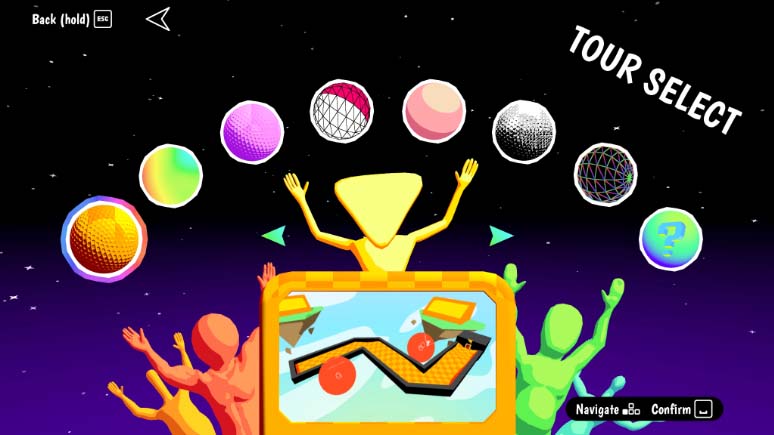
Playtesting was essential for finding the fun, or problems, of any given course. For example, we soon found out that steep slopes you need to shoot up should be used sparingly as they often kept players stuck: undershoot and your ball rolls all the way back down, taking your turn with it. In a turn-based party game, however, we saw it become a Sisyphean task, where players had to wait a full round just to push the boulder again, possibly just to get knocked down again by another player. Every obstacle type in our toolbox, we noticed, had a “question” that it asked players to answer with their shot. And it turned out some of these possible answers could take the form of items.
That realization reframed the whole game for us. In traditional mini golf your only solutions are power and angle. Items let us hand players entirely new solutions. Rolling back down those slopes? We made Early Stop, an item that halts your ball whenever you want (Hint: your ball can stop mid-air!). We started running this loop on purpose: find the trope, name the frustration, build the item that resolves it.
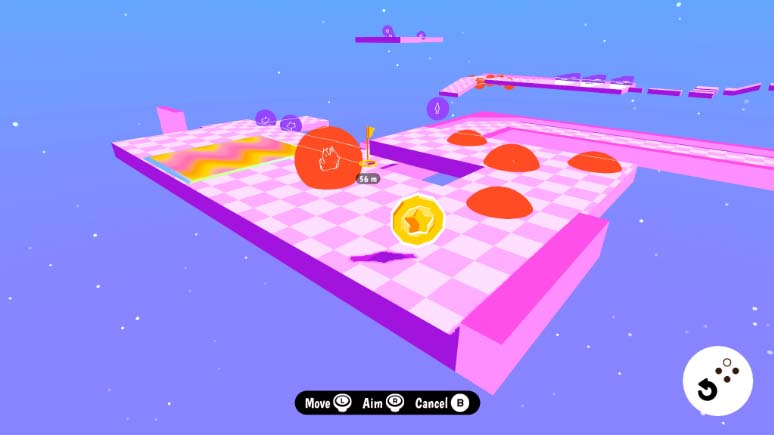
Then we discovered the loop runs both ways, because items redesign your courses right back. To keep things balanced, we added some additional walls and obstacles that had no effect on regular play, but blocked some specific item skips that were just too powerful. On one early course, we placed the starting platform a little too close to the cup…. as a result anyone using the Portal item could skip straight to the cup with no thought at all (we moved the platform). Still, players were having more and more fun exploring the limits that each item could take them to.
سەرچاوەی فەرمی بە زمانی ئینگلیزی: https://news.xbox.com/en-us/2026/08/31/hole-in-zero/