Deadpool’s a weird character. Like fellow mutant Wolverine, Wade Wilson is a trained killer whose primary superpower is a healing factor that lets him recover and reform from any wound, even if bisected or decapitated. Unlike Wolverine, Wade knows he’s in a fictional medium, be it a comic book, movie, or game, and physically can’t stop quipping about that fact and referencing things in and out of his world. It’s up to the writer whether this is sheer coincidence (as in, he’s genuinely just psychotic and his insane ramblings happen to be the truth), or a true meta awareness granting him power over narrative itself.
This is a trait that Marvel Tōkon: Fighting Souls handles smartly, which in a way is surprising, because it usually makes him quite annoying. In most appearances, Deadpool references everything — nothing is safe. Marvel editorial, art of all mediums new and old, assorted real-life celebrity drama, specific stories from comics’ past (not just Marvel, either), and more I can’t think of right now; all of it ripe fruit for Wade to riff on in one of the many jokes-per-minute spouting from his scarred mouth. This became true of the vast majority of his comic runs, once the meta awareness, fourth-wall-breaking became a central part of his character identity, and defined non-comic appearances like High Moon’s 2013 Deadpool game and Ryan Reynolds' (admittedly, kinda perfect) portrayal from the 2016 film onwards. No, X-Men Origins: Wolverine does not count.

The problem is that this is an exceedingly difficult superpower to write well. Deadpool is designed to be annoying, yes, but specifically to the characters in the story. Creator Rob Liefeld intended for him to be "Spider-Man, except with guns and swords, and a jackass." The X-Men and the Avengers are sick of his shit, as are his villains, and that’s the core of his comedic approach: wearing people down with his relentless quips, sophomoric insults and incomprehensible (to them) references to universes beyond.
The problem arises when Deadpool starts annoying the audience, and in a way that isn’t intentional; when Wade’s voice grinds on me as much as it does Wolverine, it stops being funny and just makes me want to stop listening. The issue peaked with that Deadpool game, in which he genuinely cannot shut up, and very quickly grates on the ears with instantly dated references and smarter-than-thou jokes on game and narrative design (as if to excuse the game’s own flaws in both). It is, and I truly hate to say this, a shining example of what’s come to be known and despised as 'Reddit humour'. Hearing Nolan North’s Wade in that game makes me miss his performance in Ultimate Marvel vs Capcom 3, a take on the character where he’s still pretty damn irksome, but is at least earnest, focusing his comedy in on Marvel and Capcom history. And, occasionally, the competitive fighting game community itself, yelling "WHERE YO CURLY MUSTACHE AT?" at a nonplussed Magneto.
With all of these past versions in mind, Marvel Tōkon’s interpretation of Deadpool carefully maintains the threshold of annoyance, limiting Wade a little and focusing on reverence over ridicule (while also bringing back Nolan North, which is vital). Rather than being aware of all media ever, Deadpool specifically bears an encyclopedic knowledge of fighting games and the culture around them. With an in-universe explanation that he somehow got his hands on a fighting game strategy guide (his reading of which happens to be his disaffected, aloof blocking animation), his moveset, voice lines, win screens, and character select portrait all borrow elements from the genre, spanning the most well-known to the most niche. I’ll try to limit myself in describing them and just focus on some personal highlights, but for a quick overview, know that he pulls from Street Fighter, Tekken, Mortal Kombat, Marvel vs Capcom itself, Guilty Gear, Blazblue, Dragonball Fighterz, and even deep cuts like JoJo’s Bizarre Adventure: All Star Battle and Street Fighter: The Movie: The Game (if you can believe such a thing existed).
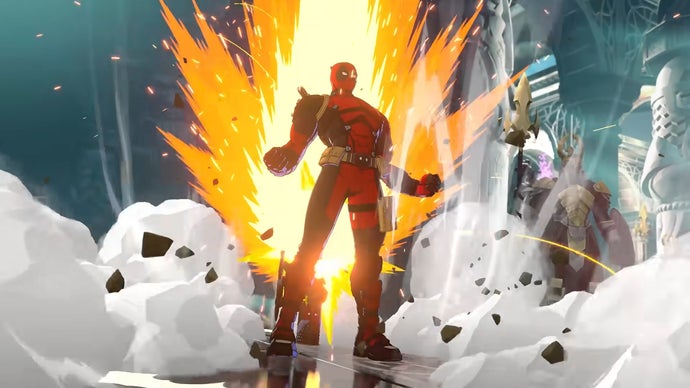
So, just for a few specific examples I love, Deadpool borrows: Cell’s intro (pictured up top), Kazuya Mishima’s Electric Wind God Fist, May’s Totsugeki (dolphin included), E. Honda’s butt slam, Doctor Doom’s Foot Dive, Johnny Cage’s nut punch, Captain Sawada’s Hara-Kiri (from SF:TM:TG!), and, somehow, Guilty Gear’s Roman Cancel mechanic, ported over entirely just for him. Several of these are only available while Deadpool is recovering from damage, self-inflicted or otherwise, tying these Fourth Wall Attacks (their actual name) to his healing factor and his casual willingness to suffer grievous bodily harm. Optimal Deadpool play requires getting hurt on purpose to access these moves, which is so antithetical to standard fighting game design that it loops around to fit Deadpool perfectly.
His Deadpool Corps super starts out with Sol Badguy's Volcanic Viper uppercut (yelled out as "AQUATIC VIPER!", what with the dolphin he’s swinging around), and his Tokon Assemble closes out with a simulated opponent ragequit — whether they do in real life is another question — followed by Dio Brando’s timestop. Did I mention Deadpool is voiced by Dio’s VA, Takehito Koyasu, in Japanese? Oh, and, finally, the variations of his reference-laden Fever Dream super include, to name a few, Wade screaming "LET’S GO, WADE!" in his own EVO Moment 37, a recreation of Justin Wong’s infamous 'friend zone' photo (poor guy), and Kazuya dropping his father off a cliff in Tekken.
Okay, that was maybe more than a few. There’s just so much packed into this character, so many more examples that James would understandably cut for length if I tried to include, and it's a joy for a girl so in love with fighting games to pick through. It's also what makes Tōkon’s interpretation of Deadpool work for me, where so many others have only irritated. At no point is his fourth-wall-breaking intended to punch down, or even sideways; there's no attempt to crudely ridicule any single person, game, movie or other creative work, as if he and his writers are so above it all. Well, maybe Wong, but I think he’s handling it well. Point being, it's much more a collection of tongue-in-cheek yet ultimately affectionate FGC in-jokes than an endless reel of smug, poorly ageing pop culture references.
سەرچاوەی فەرمی بە زمانی ئینگلیزی: https://www.rockpapershotgun.com/the-importance-of-being-earnest-how-marvel-tokons-deadpool-trades-ridicule-for-fighting-game-reverence