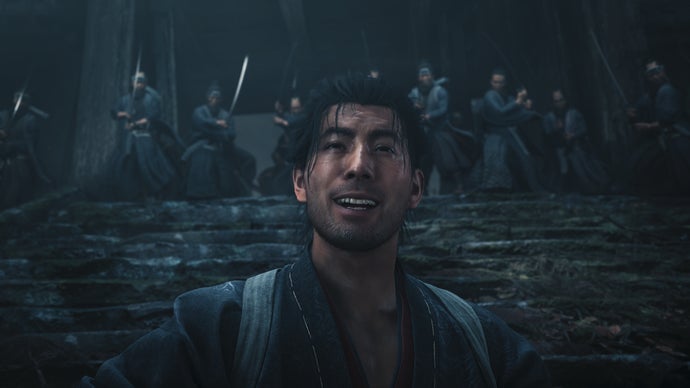
The opening minutes of Onimusha: Way of the Sword are glorious, in the sense that they’re utterly shambolic. Wandering ronin Musashi wakes up under a bridge, belts a wrong-footingly British "WOT?!" at some starving urchins eyeing up his rice ball, then proceeds to be chased around a muddy village by what feels like two thousand martial arts students, only occasionally stopping to boot a wooden plank into their faces or scoop up an imperilled dog. It’s goofy and brash and genuinely funny, in a way that immediately looks to elevate it among the field of po-faced fantasy slashers as effectively as any well-honed parry mechanic.
Why in the following hours, then, does Way of the Sword make only occasional attempts to match this intro’s energy?
I’m only a handful of bosses deep at the moment, so if this assessment turns out to be untrue of the latter half, I’ll trying doing a spot of seppuku with this pen lid on my desk. But so far, nu-Onimusha seems to be wanting it all, tonally. Sometimes it’s macabre feudal-horror. Sometimes it gives Mushashi the invincible aura of a shonen manga hero. Sometimes, it simply stays quiet while you follow map markers around Kyoto.
Underneath all this is, no question, an astutely built action adventure, with – as you’ve surely read about elsewhere by now – one of the smoothest, clangiest sword-deflecting moves in the rapidly expanding sword-deflecting business. It’s a fine game. It just could have been a great one if it went for a laugh more often.
If it did, it would only be sticking to what it’s already good at. That introductory sequence works so well because it both builds up and tears down Musashi as the picture of a master swordsman, one who confidently triumphs in a duel moments before taking a faceful of pig turds as he flees from his victim’s army of disciples. I love watching Way of the Sword’s main man variously slice and stumble through his scenes – Capcom have animated him beautifully, from his awkward shuffling as he tries to squeeze out of a narrow hideyhole to the wonderfully expressive contortions of his easily perplexed face (belonging, originally, to samurai cinema icon Toshiro Mifune). Sometimes all it takes to induce a smile is a shot of his scrunched-up brow and bewildered pout, and the visuals are consistently matched with pitch-perfect line readings by English VA Kenichiro Thomson.
Even the fighting can be funny. With or without the cursed arm, combat is heavily physical and surprisingly reactive, meaning you can pull moves like redirecting a charging enemy into another enemy with a parry – sending them clattering into each other with such stance-breaking force that the game might as well have played a ‘bonk’ sound effect. Abusing attackers’ momentum like this can also send them faceplanting into walls or, if they’re a spikier sort, embedded within walls, where they’re forced to flail helplessly. And, amusingly.
Way of the Sword goes as far as to dip into Jackie Chan prop-fu, furnishing certain environments with boards, carts, or chuckable barrels to use as improvised weapons. Again, it’s presented more silly than desperate, and there’s something inherently hilarious about vanquishing an ancient, arcane evil with what is essentially a big wheelbarrow. Sadly, like the humour of that opening chase, this is something that’s introduced early and then only occasionally revisited, with planks and battle-carts only lightly sprinkled across Way of the Sword’s environments. Straight sword duels are more honourable and, again, formulated well enough, but unless you luck into a funny physics interaction, they typically aren’t as memorable as when you get to weaponise detritus.
Granted, for a consistent comedy angle to work, Way of the Sword would need to be cut down significantly. Except it probably should have been anyway, as the initially lively pacing is quickly curbed by myriad cutscenes and NPC conversations, only some of which bother with a good joke (or Musashi grimace). The semi-open world structure is weird, too. While adding little in terms of story and action possibilities, Kyoto’s layout effectively keeps you moving through corridors anyway, and it’s hard not to wonder if a more compact and focused format would have better served both the combat and the presentation. As it is, there are times when these highlights are spread out not just by something worse, but by nothing much of anything.
سەرچاوەی فەرمی بە زمانی ئینگلیزی: https://www.rockpapershotgun.com/onimusha-way-of-the-sword-is-best-when-its-silly-and-despite-some-gloomy-open-world-slogging-sometimes-even-remembers-it