The Tristia series is one people worldwide might not have really heard about until the 2023 releases. They’re essentially inventor simulations that involve a teenage girl bringing a devastated community back to life and relevance. Because of their age, it means they can feel a little more difficult and dated like older Atelier games like Marie: The Alchemist of Salburg. Now that Tristia: Chronicles brings Legacy and Tristia to the Switch, it feels a look back into what these older sorts of simulations were like. However, I will say that Tristia: Legacy is the real draw in this compilation. Unless you’re a super fan of Kogado’s Deep-Blue, you should only buy it alone and forget about Restore.
Both Tristia: Legacy and Restore follow Nanoka Flanka, the teenage granddaughter of a famous designer, engineer, and inventor Prospero Flanka. The struggling island city of Tristia needs help, following a dragon attack a few years back, and called upon Prospero for help. However, due to an illness, Nanoka’s been sent in his place. While she’s fully certified and established on her own, her age means people underestimate her and immediately write her off. After fixing a fountain relic relying on ancient technology, Priestess Reygurett becomes her fan. Soon, Nanoka has a year to make a difference and restore Tristia.
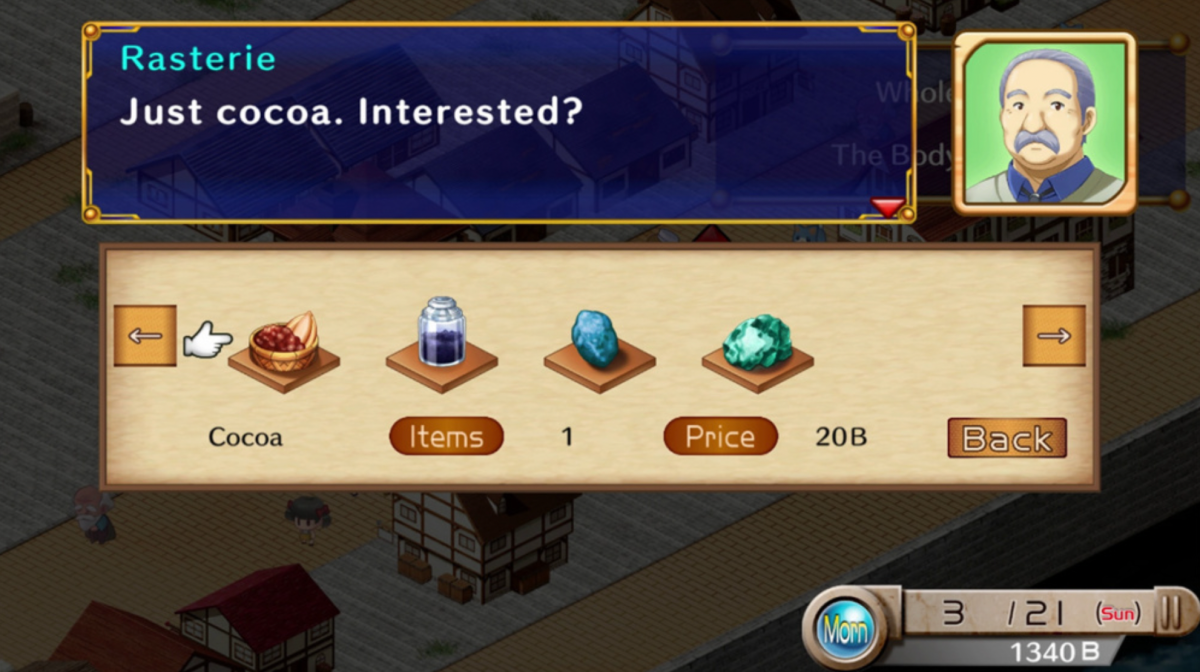
Both Tristia: Legacy and Restore feature a similar premise and story, as they take place during the same time period, but feature different kinds of gameplay. Legacy is more of a straightforward simulation with visual novel elements and is the original title that told about Nanoka’s endeavor to aid Tristia. We get a year to revitalize the town via her inventions. That means exploring town and areas to trigger events and get ideas, getting items from the craftsmen and folks in town, researching them to come up with ideas, and crafting things based on that, all in the hopes of helping and completing requests tied to the story. Like the Atelier series, time passes as you perform actions like research, crafting, or sleeping, and it is possible to fail when working on a recipe.
The “dated” element of it comes from how assignments and the creation process is presented. When you get past the introduction and are established in your own studio, Stuka only offers you the tutorial once. Do not say no, as it is your only chance to learn what to do. Even then, it isn’t as insightful or helpful as it could be. Once you do get into the design process, the menu doesn’t offer as much insight as I hoped into what to expect. It can also be difficult to work out timelines, since it’s coming from a time period when players probably were expected to keep additional notes about schedules. I’d almost call it something of an artificial difficulty, since it isn’t too challenging to work out your steps and what should be done, but the way information is conveyed can make it challenging.
Meanwhile, Tristia: Restore is the more active take on the Chronicles storyline. Nanoka still is coming up with inventions to restore the town, but it happens over stages. You are crafting still! In this case, you’re heading to different stations in the workshop to complete quick-time-event types of minigame tasks to accomplish goals while upgrading the stations you use and avoiding time-stealing obstacles. If you complete the stage’s item creation and monetary objectives before time runs out, you can move on to the next stage.
Here’s the thing. Tristia: Restore isn’t fun. Even though this is a modern release, the tutorial is just as bad as the one in Tristia: Legacy. It involves a ton of QTEs that are overwhelming and tedious. Every recipe you need to craft has its own time limit in addition to the overall one for the stage, and you also need to keep up with which ingredients and steps you need for every one of them since the UI isn’t some super helpful cheat sheet for what you should be doing next to succeed. It sort of feels like everything that made Tristia: Legacy charming and enjoyable is absent in Restore, with only frustration and tedium left behind.
Tristia: Chronicles is an insight into revival of a classic series on Switch, but Legacy is the only game worth owning in the collection. It’s a look back into a classic simulation and Deep-Blue series beloved enough to inspire follow-ups and an anime. Modern quality-of-life elements are absent, but it’s a fascinating look back at an Atelier style simulation. Tristia: Restore is a confounding take on the story with unenjoyable minigames and tasks. While the overall score here is a 6 out of 10, I’d say Tristia: Legacy is a pretty solid 7 and Restore is closer to a 4 or 5.
Tristia: Chronicles’ Legacy and Restore are available on the Switch and PC. The game also appeared on the PS2, PSP, and PC in Japan.
سەرچاوەی فەرمی بە زمانی ئینگلیزی: https://www.siliconera.com/review-tristia-chronicles-feels-like-an-atelier-style-retro-simulation/