
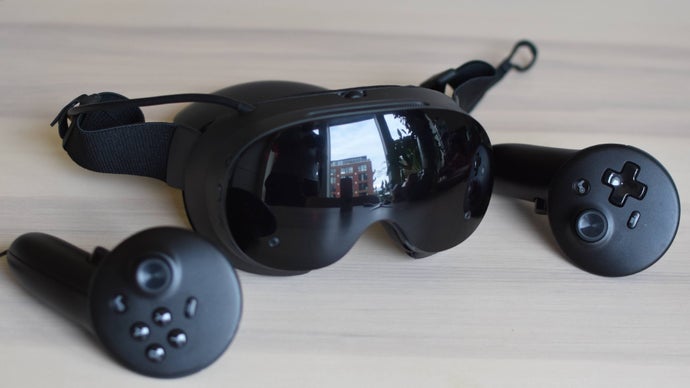
It’s a strange time to be selling a new VR headset, and maybe an even stranger time to be buying one. The supply of original virtual reality games has slowed to a dribble, and just as with Valve’s last hardware launch, the Steam Frame arrives covered in bumps and scrapes from a fight with the worst components shortage in memory. A fight which, judging by how it’ll cost ya £889 / $1,059 at minimum, it lost.
However, something else the Frame has in common with the revamped Steam Machine is that as a piece of hardware per se, it’s really quite likeable. Charismatic, even. It’s a happy marriage of core VR capability and genuinely new engineering ideas: some simple practicality boons, some with the potential to change PC games as we know them. And not just the ones you’d play with sweaty goggles on your face.
These ambitions aren’t necessarily apparent from the moment you lift the Frame (and its two controllers) from the box, but it still makes a good first impression. Despite being a fully wireless, battery-powered kit, it’s lighter, more compact, and far easier to set up than its cabled and base-stationed Valve Index ancestor. Its two 2,160x2,160 LCD lenses also make for a tidy sharpness upgrade, while narrowly edging the overall resolution of the Frame’s sworn enemy: the similarly cable-cutting Meta Quest 3. Prescription lens inserts are being made by Zenni Optical, but I can just about find a comfortable fit for my fairly hefty glasses, so fellow four-eyes – unless you’ve got Farnsworth-spec specs – probably won’t need them.
The Frame’s controllers do lack the hyper-accurate finger tracking of the Index’s, a quality their capacitive sensors are only partially successful in trying to recreate. Otherwise, though, they don’t feel like downgrades. Their inside-out tracking is plenty accurate, and although the adoption of a more gamepad-style, XYAB 'n' D-pad layout was done with playing 'flat' games in mind – more on that later – there’s something comfortable and immediate about using VR controllers with the same inputs as a conventional gamepad. Borrowing the grippy, drift-resistant tunnelling magnetoresistance (TMR) thumbsticks from the new Steam Controller was an especially wise move.
Passthrough play, where onboard cameras feed a view of your surroundings to use as game backdrops, is relatively basic. It’s fine for a few quick rounds of 3D puzzlebuilder Cubism, but the Frame’s monochrome cams represent one of the few areas where the clearer, full-colour Quest 3 has it beat. I’m not personally too fussed about this, mind – you can ask Meta themselves how well whole mixed reality Metaverse thing went, and the Frame’s video quality is fine for, say, quick trips out of the play area to retrieve a vibrating phone.
I hear that that a third-party, colour camera accessory is also in the words, though the usefulfulness of Steam Frame feature this relies on – its modularity – is difficult to assess in its earliest days. It sounds great on paper: besides staples like lens inserts, the idea is that you can swap out parts of it – the strap, the speakers, the battery, the facepad, to name a few – and replace them with more advanced or comfortable modules. Still, how valuable this will be depends on the available modules, and at the time of writing (a few hours before launch) the only add-ons to be officially confirmed are those of Valve’s own Ergonomic Accessories Kit, a pack of improved straps for the controllers and headset.
Happily, the Frame gets flexible and functional well before you’ll feel the need to start yanking bits out of it. Much of this flexibility derives from an exceptionally thoughtful balance of streaming and standalone usage, to the point where the Frame doesn’t feel as if it favours one VR style even as it excels in both.
Thus, streaming from a PC – your best bet for maximum visual fidelity – is helped along by a number of honest-to-goodness tech innovations. Foveated streaming, for one, makes use of the Frame’s eye tracking (itself an entire feature that both the Index and Quest 3 lack) to only stream a full-quality image where you’re currently looking at. Peripheral vision areas are streamed in lower quality to save bandwidth and, by extension, keep performance high. The transition between the two qualities is near enough instantaneous, so I couldn’t perceive it happening unless I stopped to look for it.
سەرچاوەی فەرمی بە زمانی ئینگلیزی: https://www.rockpapershotgun.com/steam-frame-review