
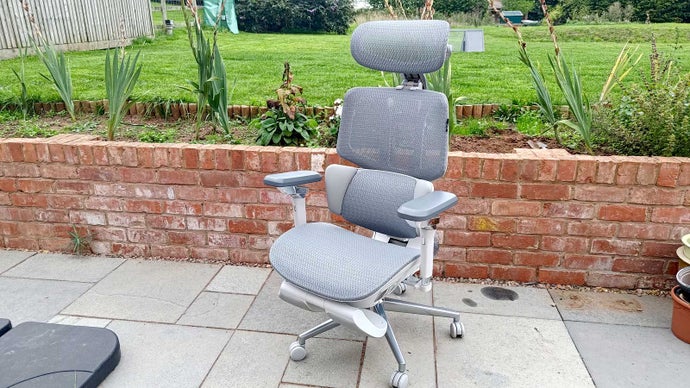
AI is everywhere, exhausting to keep up with, and increasingly perceived as harmful to games. But that’s mostly generative AI; the more limited, less media-scraping and energy-hungry breeds of artificial intelligence can still play a harmless, maybe even useful role, especially on the hardware side. Even if it finds itself in some unexpected places, as is the case with HBADA’s X7 chair.
While AI-powered lumbar support sounds like the kind of gimmicky nonsense that’s become all too common in 2026, I’ve been using an X7 for a week, and it’s... surprisingly effective? To the point where it’s literally changed my spine for the better, helping to deal with my recurring back pain and posture issues. It’s been a very pleasant surprise.
Granted, it had better yield results for the price. The X7 is on an Autumn sale at the time of writing, and it’s still £1,169 - at a time when most of the PC components you’d use while sitting in it are historically expensive. Rightfully, it does at least throw the kitchen sink at its features list: 720-degree adjustable arm rests, a built-in footrest, a 4D adjustable headrest, an "8D bionic" back massager, a "cloud ventilated" seat cushion with cooling fans, and a "graphene heating and red light therapy," system all come as standard.
Considering the bevy of buzzwords and baubles, I was extremely sceptical of HBADA’s "Automotive grade", AI-based smart lumbar system. Surely nobody actually needs an artificial intelligence to manage the placement of their lumbar support. And even if they did, what would it actually do?
As it turns out, the X7’s application of machine learning is high-tech for a chair, but relatively simple by today’s AI standards. The automatic adjustment works by, firstly, using magnetic sensors to detect the amount of pressure you’re placing on the lumbar support at any given time. The chair then reacts accordingly, either retracting the lumbar support, or extending it. The idea is to respond to your movements, so regardless of whether you’re pressed back in your seat, relaxed, and lounging, or pushed right forward, engaged and furiously mouse-clicking, your lower back should get the appropriate amount of support.
Ultimately, it’s less some kind of large language model for your back, and more just a smart pressure sensor. Still useful, still effective - for me, anyway - but if there’s anything truly artificially intelligent about this chair, it likely falls outside the modern colloquialism. ChatGPT on wheels, this is not.
Regardless of whether you find that a disappointment or a relief, the X7’s pressure responsiveness, built-in kneading massager, and heating element combine to form a piece of swivelly furniture that I found genuinely useful for maintaining comfort while I played and worked. In the process, it even taught me a little something new about my seated posture. Not immediately, granted, but then that proved to be my own fault.
It may not have helped that I began my relationship with the X7 by giggling at it. "Come and try this", I laughed to my wife, almost immediately after getting it out of the wrapping. As I had done moments before, she sat on the chair, got comfortable, and then I switched on the smart lumbar support. It proceeded to push her forward to its full extent, almost shoving her off the chair.
سەرچاوەی فەرمی بە زمانی ئینگلیزی: https://www.rockpapershotgun.com/im-not-sure-the-ai-in-my-chairs-lumbar-support-actually-counts-as-ai-but-it-has-been-smart-enough-to-fix-up-my-spine