BioEden is set in a post-apocalyptic future shaped by solarpunk ideals, a speculative movement imagining a hopeful world powered by renewable energy and ecological balance.
Humanity has expanded into space, and colonization is now overseen by the Collective, a political assembly made up of rival space-faring guilds. Earth itself has become inhospitable, and most animal species are extinct. The Collective’s mission is to coordinate the guilds’ efforts to revive the life that’s been lost, whether the cause was climate collapse or the civilizations that once called these worlds home. To the Collective, the reason doesn’t matter. Only recovery does.
It’s a setting tailor-made for a 4X game.
The name comes from four verbs that define the genre: eXplore, eXpand, eXploit, and eXterminate. Exploration drives the early game, as players uncover a map, often procedurally generated, that rewards curiosity and careful scouting. Expansion follows naturally: growing an empire through new colonies, stronger infrastructure, and wider political or economic reach. That growth feeds into exploitation, where the resources players discover get put to work, whether that means fueling a military machine or generating wealth. And almost inevitably, it all builds toward extermination: combat in some form, with eliminating rival civilizations baked into nearly every 4X game’s victory conditions.
It’s a formula built on acquisition and dominance. BioEden‘s developers looked elsewhere for inspiration, toward cozy, environmentally minded management games like Terra Nil, The Wandering Village, and Timberborn, all of which center the player’s relationship with nature rather than rivalry. So instead of the 4X, BioEden builds its identity around the 4R: Restore, Relax, Revive, Recycle. Yves Hohler, CEO and Creative Director at Broken Arms Games, puts it simply: “BioEden isn’t about conquering a world. It’s about helping it heal, because every world deserves a second chance. We wanted to make a game where restoring nature is more rewarding than exploiting it.”
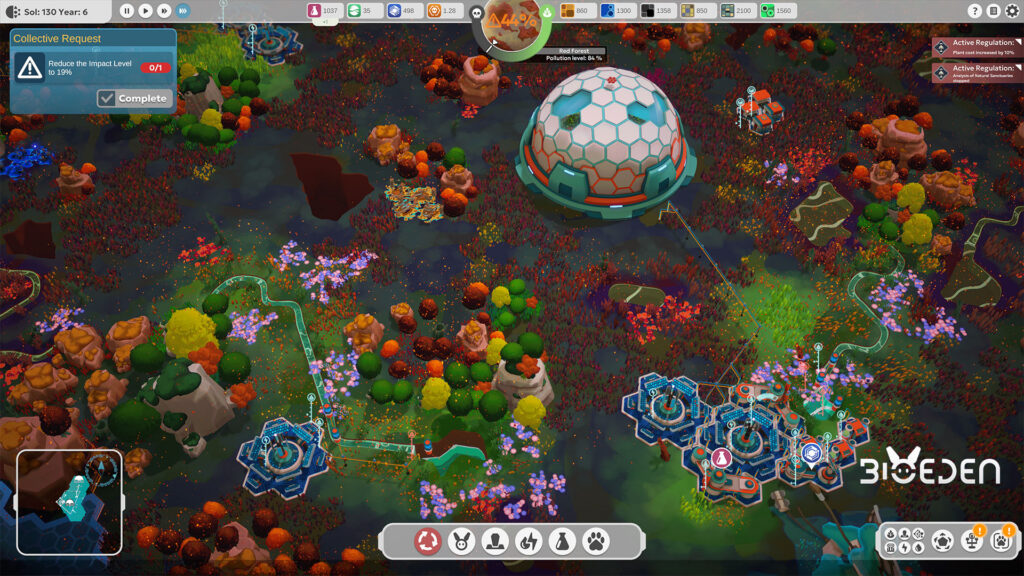
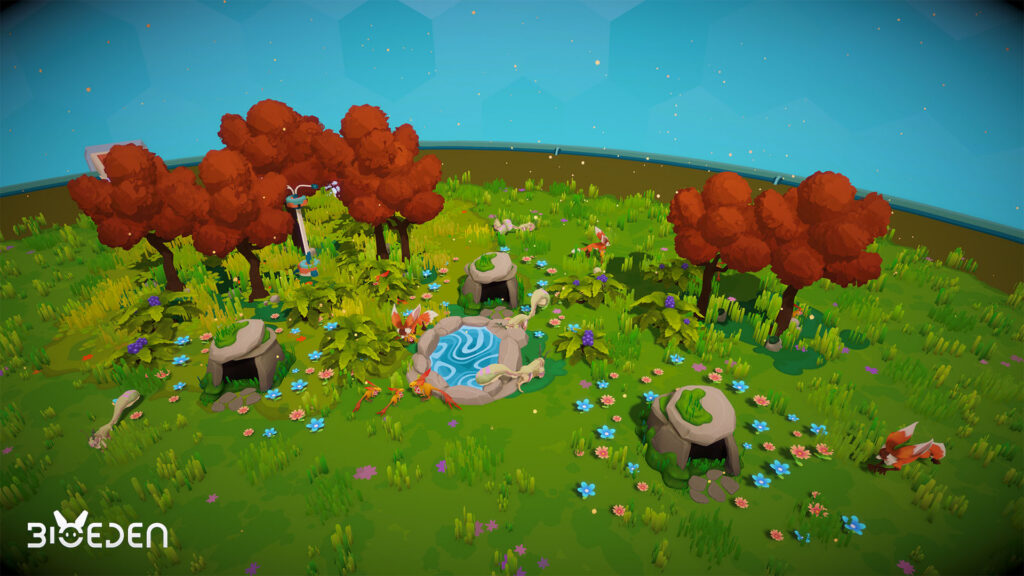
Indeed, Restoration drives the game, as players clear debris and purify polluted land and water, undoing the damage left behind and preparing the planet for its future, as a peaceful Eden. Relaxation follows naturally: with no rival empire and no clock running out, players are free to build at their own pace, without pressure. That patience feeds into Revival, as cleaned and stabilized land becomes hospitable again, first to plants, then to the extinct animal species players work to bring back. And at the center of it all sits Recycling: any building can be dismantled at any time, its resources reclaimed and every trace of it wiped from the planet, as if it had never been built.
The 4X’s structural bones are still there, just aimed differently. Classic 4X games usually start players off with a blank slate (no research, no technology, no culture) so that every civilization builds itself up from nothing. BioEden borrows this framework loosely: rather than a tech tree built for territorial gain, players progress through story beats, choices, and requests that earn trust with their guild, unlocking new buildings and upgrades along the way.
Diplomacy gets the same twist. In most 4X games, diplomacy plays out between rival players or AI-controlled empires, ranging from friendly to openly hostile. In BioEden, there’s only one relationship that matters: the one between the player and the planet itself. How the world responds is shaped entirely by the player’s choices and playstyle.

سەرچاوەی فەرمی بە زمانی ئینگلیزی: https://news.xbox.com/en-us/2026/09/03/bioeden-4x-to-4r/