
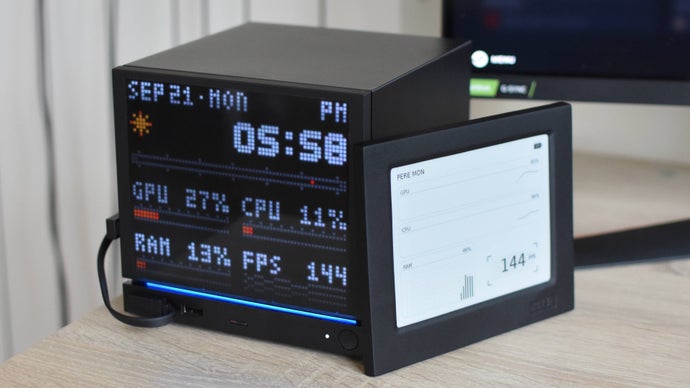
If you own a Steam Machine, and still cling to the misconception that my budget faceplate ideas aren’t good enough for you, you basically have three options for front panel customisation. The first is to grab something off Etsy or suchlike. The second is take advantage of Valve’s open-source Inkterface project to build yourself an E-Ink display, onto which you can electronically daub performance monitoring info. The third is to end up with more or less the same panel as option two, but have someone else make it for you. That’s what arch accessory makers JSAUX are proposing with their Steam Machine E-Ink and Pixel Matrix faceplates, which go on sale today after a few weeks of preening around the case mod scene.
I’ve been using both on my Machine at home, and they’re quite good fun. The E-Ink faceplate, for which I sense the greater internet buzz, is a crisp, tidy little black-and-white panel, while the PixelMatrix trades detail density for colour and retro charm. Both have a few different display modes, switchable in SteamOS’s quick settings menu (via some clever integration with the Decky Loader plugin tool), and while I had to set this up manually, JSAUX say the requisite software will be downloadable via Steam itself from early October. Truly, it’s all the results of a DIY mod and more, conveniently pre-prepared for people who don’t own soldering irons.
Of the two, I narrowly prefer the PixelMatrix, that favouritism expanding significantly when using a faceplate for performance monitoring. The E-Ink model is pretty knackered in this respect, as its fastest refresh speed option is a hardly widowmaking once per minute, and I’m rarely interested in what my Steam Machine’s GPU was doing sixty seconds ago. I also, uh, like how the sun is actually yellow on the PixelMatrix’s weather view. This is apparently what RPS hardware coverage has come to.
Tell you what, here’s a cat picture. One advantage the E-Ink screen has over the dot matrix is that it makes much, much more sense for turning the Steam Machine into a digital photo frame; this holiday snap of a stray Baku resident was just too detailed for the PixelMatrix’s chunky LEDs to recognisably reproduce. The latter might work for pics of your favourite Jenga block, or perhaps an ironic, front-on photo of the Steam Machine itself, but for anything with eyes or hair you’re better off with the E-Ink.
Granted, this isn’t the only shortcoming. I find it disproportionately annoying that the outer edges – on both faceplates – don’t quite line up perfectly with the USB/power button/ light strip section on the Machine’s bottom lip, and the right-sided USB-C port on the E-Ink panel forces the connecting cable to stretch unattractively across the same section. The FPS 'counter' on each screen’s performance monitors also downright misleads: it displays your TV/monitor’s refresh rate, in frames-per-second instead of Hz, and not actual in-game performance. It wouldn’t be very useful to get a once-per-minute framerate update on the E-Ink model anyway, but still.
At least when the E-Ink screen does refresh, though, it does so faster and less distractingly than Valve’s Inkterface design. A design which, if you follow the instructions by the book, will also give you a single performance monitoring screen, not the choice of performance, play time tracking, clock, weather, calendar, or photo frame modes that JSAUX’s ready-made screens have out of the box. And, in a major break from PC hardware convention, they both work out cheaper than taking the DIY option.
Now, "cheaper" doesn’t necessarily mean "cheap" - the E-Ink is $100 and the PixelMatrix is $90, or roughly a tenth of the infamously ‘spenny Machine it latches onto. These are undoubtedly luxuries, for those who didn’t already blow their entire luxury budget on miniature PCs. Yet totting up the combined component prices of what you’d need for an Inkerface panel reveals it to cost $104.50, not including the expense of either 3D-printing the external housing or buying something pre-printed for an additional 15 dollaridoos.
In a sense, then, the $100, sub-6in greyscale screen that only refreshes once a minute is... good value. Weird! But probably fine. Now I cross my fingers and hope Valve don’t kill it off in a few days’ time, like the last Steam Machine accessory I tried.
سەرچاوەی فەرمی بە زمانی ئینگلیزی: https://www.rockpapershotgun.com/prebuilt-steam-machine-faceplate-screens-are-here-delivering-decent-surprisingly-cheaper-alternatives-to-valve-approved-diy-builds