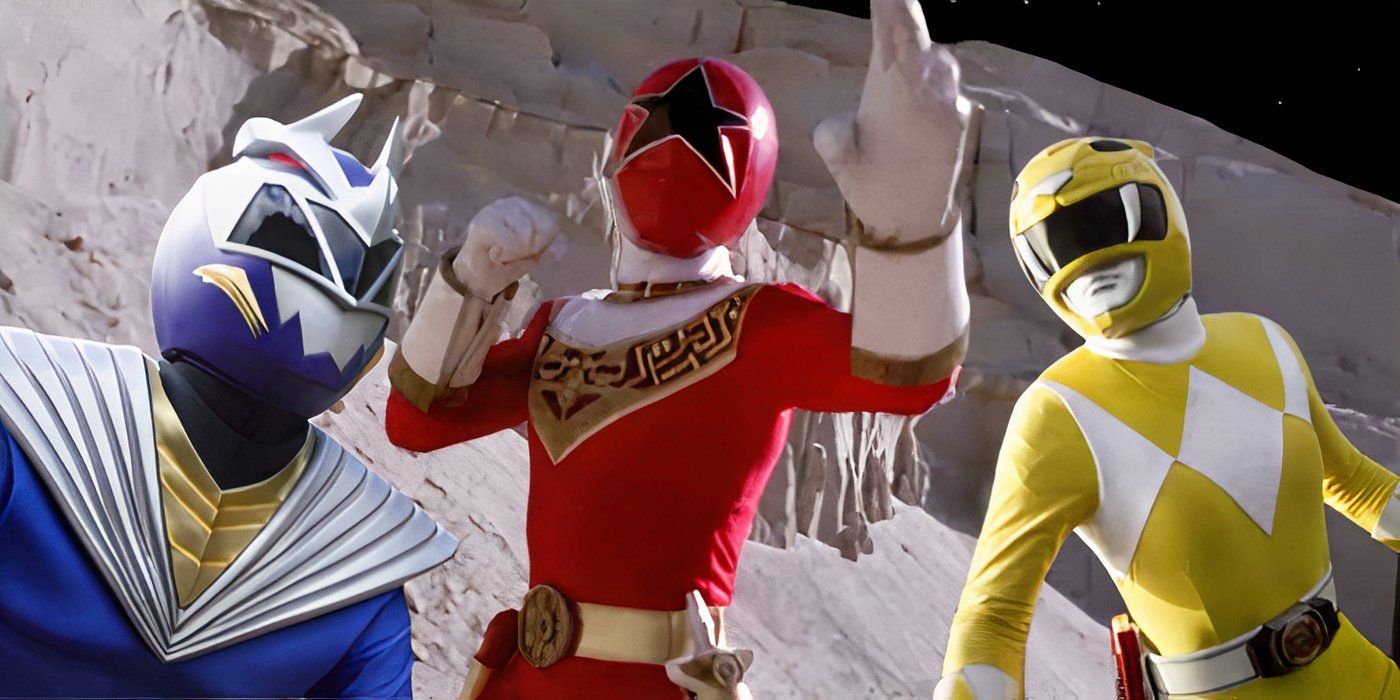
Few things are more immediately recognizable about Power Rangers than the colors of its heroes. Even non-Power Rangers fans can probably name the first six colors of the Mighty Morphin’ Power Rangers. However, when fans who have followed the teams through the years see a Ranger, a whole visual language is revealed: a brightly colored hero, a distinctive suit, a signature weapon, a place within a larger team, and a role shaped by decades of Power Rangers stories.
That color-coded system is one of the franchise's greatest strengths. It allows a team of strangers to become visually distinct in seconds, makes action scenes easier to follow, and gives every Ranger an identity that can be understood before a character even says their name. Red, Blue, and Yellow Rangers have become especially familiar because they appear again and again across Power Rangers history.

Power Rangers was built from footage, costumes, concepts, and characters originating in Japan's Super Sentai franchise. The multicolored team was already an established idea long before Mighty Morphin Power Rangers premiered in 1993. The first Super Sentai series, Himitsu Sentai Gorenger, established a particularly influential five-color lineup: red, blue, yellow, green, and pink. Later series experimented extensively with those ingredients, sometimes replacing colors, reducing the number of heroes, or adding new ones, but red, blue, and yellow emerged as the most frequently used colors.
That history matters because Power Rangers did not invent the idea that each color could communicate a character's place within a team; instead, it inherited a visual vocabulary that Super Sentai had already spent years developing. Although there have been teams built around Red, Blue, and Yellow Rangers as a trio, including Hurricanger, Abaranger, Gekiranger, and Go-Busters, other teams have substituted black, green, white, pink, or entirely different colors. In other words, the color system was designed to be flexible from the beginning.


Of the three colors, the Red Ranger has the strongest association with leadership. That connection was already firmly established in Super Sentai, where the red hero frequently occupies the central position. The reason is partly practical: red is visually striking, so in a group of brightly colored heroes, it naturally attracts attention, making it useful for identifying the character the audience is supposed to follow. But the Red Ranger has never been locked into one personality.
Early Red Rangers, like Jason Lee Scott, were straightforward heroic leaders, while later characters expanded the archetype considerably. Jack Landors in Power Rangers S.P.D. begins as a streetwise thief rather than a conventional authority figure. Casey Rhodes in Jungle Fury begins as an inexperienced student. Wesley Collins in Time Force doesn’t lead the team until later in the season. That evolution demonstrates an important distinction: the color stayed recognizable even as the character attached to it changed. Red eventually represented importance, not necessarily just leadership or a specific personality type.
If the Red Ranger is often the team's center, the Blue Ranger has historically functioned as something of a counterweight. Blue Rangers have frequently been associated with intelligence, technical expertise, calmness, discipline, or a more analytical temperament. Billy Cranston was the original Blue Ranger, acting as the team's science-minded problem solver and establishing the mold that later Blue Rangers could inherit, modify, or deliberately reject. However, the archetype has never been limited to just "the smart one." Tori Hanson in Ninja Storm is an accomplished surfer and a confident fighter. Koda in Dino Charge completely disrupts the expected mold: he is a prehistoric caveman whose limited understanding of the modern world becomes part of his charm.
That variety helps explain why Blue Rangers are so useful. The color can suggest competence without dictating exactly what kind. The Blue Ranger also provides a visual and dramatic contrast to the Red Ranger. When Red is impulsive, Blue can be cautious. When Red is emotional, Blue can be rational. When Red is inexperienced, Blue may bring knowledge or technical skill. These aren't universal rules, but the contrast is so familiar that writers can exploit or subvert it almost effortlessly.
سەرچاوەی فەرمی بە زمانی ئینگلیزی: https://gamerant.com/why-red-blue-yellow-rangers-common-power-rangers/